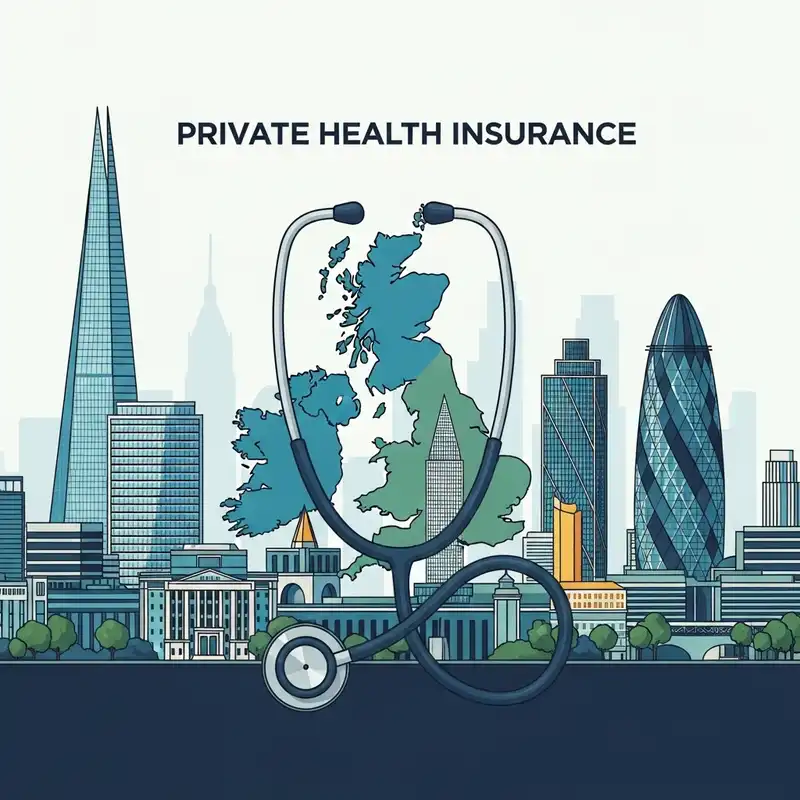
TL;DR
Moving to the UK from the US brings a whirlwind of new experiences, from navigating roundabouts to deciphering local accents. But one of the most significant adjustments is the healthcare system. As an FCA-authorised broker that has assisted with over 900,000 policies, the experts at WeCovr specialise in helping US expats understand their options, from the state-funded NHS to the world of UK private medical insurance.
Key takeaways
- GP (General Practitioner) services: Your family doctor for day-to-day health issues.
- Hospital treatment: In-patient stays, surgery, and specialist consultations.
- Emergency services: Accident & Emergency (A&E) departments.
- Maternity services: All care related to pregnancy and childbirth.
- Mental health services.
Moving to the UK from the US brings a whirlwind of new experiences, from navigating roundabouts to deciphering local accents. But one of the most significant adjustments is the healthcare system. As an FCA-authorised broker that has assisted with over 900,000 policies, the experts at WeCovr specialise in helping US expats understand their options, from the state-funded NHS to the world of UK private medical insurance. This guide is your definitive resource for 2026.
UK Private Healthcare vs NHS for Us Expats Costs Insurance Guide
For Americans accustomed to a market-driven healthcare landscape, the UK's dual system can be confusing. You have the National Health Service (NHS), a comprehensive, state-funded system free at the point of use. Alongside it, a vibrant private healthcare sector offers an alternative route for faster, more flexible treatment, funded by private medical insurance (PMI).
This guide will demystify both systems, helping you make an informed decision for yourself and your family.
Understanding the UK's Two-Tier Healthcare System: NHS vs. Private
Think of the UK healthcare system as having two parallel tracks. Every legal resident is entitled to use the NHS track, but you can also choose to pay for the private track when you need it.
- The National Health Service (NHS): Funded by general taxation and National Insurance contributions, the NHS provides comprehensive healthcare to all UK residents. Its founding principle is that care is provided based on clinical need, not the ability to pay.
- Private Healthcare: This sector is made up of private hospitals, clinics, and specialists. You can access it by paying for treatment directly ("self-pay") or, more commonly, through a private medical insurance policy. It works alongside the NHS, not as a complete replacement.
Here’s a simple breakdown of the key differences:
| Feature | National Health Service (NHS) | Private Healthcare (via PMI) |
|---|---|---|
| Cost at Point of Use | Free (for most services) | You pay an insurance premium & potential excess |
| Funding | UK taxation & National Insurance | Insurance premiums or self-funding |
| Waiting Times | Can be long for non-urgent care | Significantly shorter, often days or weeks |
| Choice of Specialist | Limited; assigned by the NHS | You can choose your specialist |
| Choice of Hospital | Limited to NHS hospitals in your area | Wide choice from a list of private hospitals |
| Accommodation | Typically a shared ward | Private, en-suite room |
| Access | Via your local GP (General Practitioner) | Often initiated via a GP referral |
| Emergency Care | Yes (A&E departments handle all emergencies) | No, emergencies are always handled by the NHS |
| Chronic Conditions | Yes, managed for free by the NHS | No, standard PMI does not cover chronic care |
The two systems are not mutually exclusive. In fact, most people with private medical insurance still use the NHS for GP appointments, emergency care, and managing long-term conditions.
How Does the NHS Work for US Expats?
One of the first questions US expats ask is, "Am I eligible for the NHS?" The answer for most is a definitive yes, but it’s not entirely "free".
The Immigration Health Surcharge (IHS)
If you're a US citizen applying for a UK visa to stay for more than six months, you will almost certainly be required to pay the Immigration Health Surcharge (IHS) as part of your visa application.
- What is it? The IHS is an upfront fee that grants you access to the NHS on the same basis as a permanent UK resident.
- Is it optional? No, it is a mandatory part of the visa process for most visa types, including the Skilled Worker visa, Spouse visa, and Student visa.
- How much does it cost? The fee is substantial. As of early 2024, the standard rate is £1,035 per year for adults. You must pay for the full duration of your visa upfront. For a five-year Skilled Worker visa, this means a payment of £5,175 per person.
Key Fact: Paying the IHS allows you to use the NHS without charge for hospital treatment, GP visits, and other core services for the duration of your visa.
What the NHS Covers (and What It Doesn't)
Once you've paid your IHS and registered with a local GP, you have access to a vast range of services:
- GP (General Practitioner) services: Your family doctor for day-to-day health issues.
- Hospital treatment: In-patient stays, surgery, and specialist consultations.
- Emergency services: Accident & Emergency (A&E) departments.
- Maternity services: All care related to pregnancy and childbirth.
- Mental health services.
However, some services incur charges, even with the NHS:
- Prescriptions: In England, there is a flat fee per item (currently £9.65, though this may change). Prescriptions are free in Scotland, Wales, and Northern Ireland.
- Dental Care: NHS dental care is subsidised but not free. There are fixed bands of charges, and finding an NHS dentist accepting new patients can be a major challenge.
- Optical Services: Eye tests and glasses are typically not covered for most adults.
Why Do US Expats Consider Private Medical Insurance (PMI) in the UK?
If the NHS is so comprehensive, why do millions of people—including many US expats—opt for private medical insurance? The primary reason is to bypass the single biggest drawback of the NHS: waiting lists.
As of late 2025, the NHS waiting list for routine consultant-led treatment in England stood at over 7.5 million. The median waiting time can be several months for procedures like hip replacements or cataract surgery.
PMI offers a solution by providing:
- Speed of Access: This is the number one driver. With PMI, you can often see a specialist within days and be scheduled for surgery or diagnostic tests within weeks, bypassing NHS queues entirely.
- Choice and Control: You can choose your consultant and the hospital where you are treated from a list provided by your insurer. This level of control is highly valued by those used to the US system.
- Enhanced Comfort: Treatment is typically in a private, en-suite room with more flexible visiting hours and better amenities, which can make a significant difference to your recovery.
- Access to Specialist Drugs and Treatments: In some cases, PMI may provide access to new drugs or treatments not yet available on the NHS due to cost-effectiveness assessments.
- Peace of Mind: Knowing you have a backup plan to get treated quickly provides invaluable reassurance for you and your family.
How UK Private Medical Insurance (PMI) Works: A US Expat's Primer
This is the most critical section for any American to understand. UK private medical insurance operates on fundamentally different principles from US health insurance.
The Golden Rule: Acute vs. Chronic Conditions
UK PMI is designed to cover acute conditions. An acute condition is a disease, illness, or injury that is likely to respond quickly to treatment and lead to a full recovery. Examples include joint replacements, cataract surgery, hernia repair, or cancer treatment.
Crucially, UK PMI does not cover chronic conditions. A chronic condition is one that has no known cure and requires ongoing management, such as diabetes, asthma, hypertension, or multiple sclerosis. These conditions are managed by the NHS.
Similarly, PMI does not cover pre-existing conditions, at least not straight away. This is a stark contrast to the Affordable Care Act (ACA) in the US.
Underwriting: How Insurers Assess Your Medical History
When you apply for a policy, the insurer will use one of two main methods to deal with your past medical history.
-
Full Medical Underwriting (FMU): You complete a detailed questionnaire about your medical history. The insurer will then explicitly list any conditions that are excluded from your policy from day one. It provides certainty but can be more complex.
-
Moratorium Underwriting (The Common Choice): This is the most popular option. You don't have to declare your medical history upfront. Instead, the policy automatically excludes any condition you have had symptoms of, received treatment for, or sought advice on in the five years before the policy started.
The Moratorium "Rule": If you then go for a continuous two-year period after your policy starts without any symptoms, treatment, or advice for that condition, it may become eligible for cover.
What Does a Standard UK PMI Policy Cover?
Policies are modular, but most will include:
- Core Cover: In-patient and day-patient treatment (costs for surgery, hospital stays, nursing care).
- Comprehensive Cancer Cover: This is a cornerstone of UK PMI. It often provides full cover for diagnosis, surgery, chemotherapy, and radiotherapy, including access to drugs not available on the NHS.
- Optional Add-ons:
- Out-patient Cover: This is vital. It covers the costs of specialist consultations and diagnostic tests (like MRI/CT scans) before you are admitted to hospital. Policies offer different levels of out-patient cover (e.g., from £500 to unlimited).
- Therapies: Cover for physiotherapy, osteopathy, etc.
- Mental Health Cover: Support for psychiatric care and therapy sessions.
What Is Typically Excluded from PMI?
- Pre-existing and chronic conditions.
- Emergency care (always go to an NHS A&E).
- Normal pregnancy and childbirth.
- Cosmetic surgery (unless for reconstructive purposes after an accident).
- Dental and optical care (these require separate insurance).
- Fertility treatments and IVF.
How Much Does Private Health Insurance Cost for a US Expat in 2026?
Your PMI premium is highly personal and depends on several key factors:
- Age: The single biggest factor. Premiums increase significantly as you get older.
- Location: London and the South East are more expensive due to higher hospital costs.
- Level of Cover: A basic policy covering only in-patient care will be much cheaper than a comprehensive one with unlimited out-patient cover.
- Excess (illustrative): This is the UK term for a deductible. It's the amount you agree to pay towards a claim. A higher excess (£500 or £1,000) will lower your monthly premium.
- Hospital List: Insurers offer tiered hospital lists. A plan covering only local hospitals will be cheaper than one with access to premium central London hospitals.
Table: Estimated Monthly PMI Costs for a US Expat (2026)
These are illustrative examples for a non-smoker on a moratorium underwriting basis with a £250 excess.
| Age | Location | Mid-Range Cover (inc. Out-patient) | Comprehensive Cover (inc. London hospitals) |
|---|---|---|---|
| 35 | Manchester | £65 - £85 | £90 - £120 |
| 35 | London | £80 - £100 | £110 - £150 |
| 50 | Manchester | £110 - £140 | £150 - £200 |
| 50 | London | £130 - £170 | £180 - £250 |
| 65 | Manchester | £220 - £300 | £300 - £450 |
| 65 | London | £260 - £350 | £380 - £550+ |
Insider Tip: The market is complex, with dozens of policy variations. Using an independent broker like WeCovr costs you nothing but ensures you are comparing like-for-like quotes from the whole market to find the best value for your specific needs.
Key UK PMI Providers for US Expats to Consider
The UK PMI market is dominated by a few major players, each with distinct strengths:
| Provider | Key Feature / Known For |
|---|---|
| Bupa | The UK's best-known health insurer with a vast network and direct access services. |
| AXA Health | A global insurance giant offering excellent digital tools and strong clinical support. |
| Aviva | A major UK insurer offering a 'Guidant' option for routing to specific consultants. |
| Vitality | Unique for its wellness programme, rewarding healthy living with discounts and perks. |
| The Exeter | A friendly society known for excellent customer service and flexible underwriting. |
A broker can provide an impartial comparison of these providers, helping you find the one that best aligns with your priorities, whether that's budget, flexibility, or wellness rewards.
Navigating the Tax Implications: A Critical Point for US Citizens
This is an area where US expats must be particularly careful, as you are subject to both UK and US tax rules.
UK Tax Implications
- Individual Policy: If you buy your own PMI policy, you pay for it with post-tax income. There is no tax deduction or relief available in the UK.
- Employer-Provided Policy: If your UK employer provides PMI as a perk, it is considered a taxable Benefit-in-Kind (BIK). The value of the premium your employer pays is added to your income, and you will pay income tax on it.
US Tax Implications (The Expat Complication)
As a US citizen, you must file a US tax return regardless of where you live.
- Can I deduct UK PMI premiums on my US tax return?
- Yes, potentially. The premiums can be included as a medical expense. However, you can only deduct total medical expenses that exceed 7.5% of your Adjusted Gross Income (AGI), and you must be itemising your deductions (which is less common since the 2017 tax changes). For most people, this threshold is difficult to meet.
- Can I deduct the Immigration Health Surcharge (IHS) on my US tax return?
- No. The IRS has not issued definitive guidance, but the prevailing view from expat tax specialists is that the IHS is a mandatory visa fee, not a payment for medical insurance or care. It is generally not considered a deductible medical expense.
Always consult with a tax adviser who specialises in US expat issues to ensure you are compliant.
The Claims Process: A Step-by-Step Guide
Making a claim on your UK PMI is usually a smooth, cashless process.
- Visit Your GP: Your journey almost always starts here. You see your NHS GP about a symptom, and they provide an "open referral" to a specialist.
- Contact Your Insurer: You call your PMI provider's claims line with your referral details.
- Get Pre-Authorisation: The insurer confirms your condition is covered and provides a pre-authorisation number. They will often give you a choice of approved specialists and hospitals.
- Book Your Appointment: You book your consultation or treatment directly with the private hospital or specialist.
- Receive Treatment: Attend your appointment. You may need to pay your excess at this stage.
- Direct Settlement: The hospital bills your insurance company directly. You don't have to handle any paperwork or large bills.
Final Thoughts: Your Healthcare Strategy in the UK
For a US expat moving to the UK, the best approach is to embrace the dual system.
- Register with a GP: This is your first and most important step upon arrival. It is your gateway to the entire UK healthcare system, both NHS and private.
- Rely on the NHS: Use the NHS for emergencies, GP visits, and the management of any long-term chronic conditions. You have paid for this access via the IHS.
- Invest in Private Medical Insurance: View PMI as your "fast track" plan. It provides the speed, choice, and comfort you may be accustomed to for non-emergency, acute conditions, giving you and your family peace of mind and bypassing potentially long NHS waits.
Navigating this new landscape can feel daunting. The expert advisers at WeCovr are here to help. We can walk you through your options, compare policies from across the market, and provide a personalised, no-obligation quote to ensure you have the right protection in place from day one. As a bonus, our clients get complimentary access to our AI calorie tracking app, CalorieHero, and can benefit from discounts on other insurance products.
Ready to secure your peace of mind?
Do I still need to pay the Immigration Health Surcharge (IHS) if I have private insurance?
Can I get UK private health insurance if I have a pre-existing condition?
Is mental health covered by UK private medical insurance?
Do US expats pay for the NHS?
Sources
- NHS England: Waiting times and referral-to-treatment statistics.
- Office for National Statistics (ONS): Health, mortality, and workforce data.
- NICE: Clinical guidance and technology appraisals.
- Care Quality Commission (CQC): Provider quality and inspection reports.
- UK Health Security Agency (UKHSA): Public health surveillance reports.
- Association of British Insurers (ABI): Health and protection market publications.